
Table of Contents
Introduction: What You’ll Learn About Microservices
Let me walk you through microservices architecture – a powerful approach that enables large development teams to build scalable applications using many loosely coupled services working together.
Understanding Microservices: The Basics
What Exactly is a Microservice?
Think of microservices architecture as breaking down a large application into smaller, independent pieces. Each service is loosely coupled and handles one dedicated function within your large-scale application.
Let me give you a real-world example. Take the Amazon Shopping app – it doesn’t run as one giant program. Instead, different microservices handle specific tasks:
- The Shopping Cart microservice manages your cart
- The Billing microservice processes payments
- The Profile microservice handles user information
- The Push Function microservice sends notifications
- The Orders microservice tracks your purchases
Here’s something important: each microservice maintains its own database. This separation is crucial for maintaining independence.
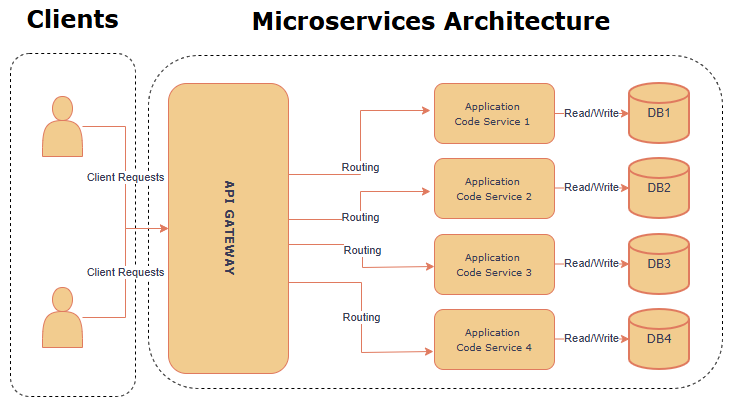
Microservices ArchitectureHow Do Microservices Talk to Each Other?
Microservices communicate through well-defined interfaces with small surface areas. Why small surface areas? They limit what we call the “blast radius” of failures and defects. This means when something goes wrong, it doesn’t take down your entire system. It also makes each service much easier to understand within the context of your complete application.
Now, let’s talk about communication methods. Microservices communicate using:
Remote Procedure Calls (RPC) and gRPC: These provide faster responses, which sounds great, right? But there’s a tradeoff – when a service using RPC goes down, the blast radius (the impact on other microservices) becomes larger.
Event Streaming: This method provides better isolation between your services. If one service fails, others remain protected. The downside? Event streaming takes longer to process compared to RPC.
Key Benefits of Microservices Architecture
Independent Deployment: Deploy with Confidence
Here’s where microservices really shine. You can deploy each service independently without touching the others. Since each service is small and easier to understand, and has a smaller blast radius, this gives you and your team peace of mind and confidence to deploy frequently.
Another major advantage: microservices give you the flexibility to scale up individual services independently. Need more capacity for your payment processing but not for user profiles? No problem – scale just what you need. This operational flexibility is invaluable for growing applications.
Strong Information Hiding: Keeping Data Secure
Well-architected microservices practice something called strong information hiding. What does this mean for you? It often means breaking up a monolithic database into logical components and keeping each component well hidden inside its corresponding microservice.
By “logical component,” I’m referring to either a separate schema within a database cluster or an entirely separate physical database – whichever makes sense for your architecture.
Important Warning: Breaking up databases comes with one big drawback you need to understand. When you separate a database into logical units, it can no longer maintain foreign key relationships and enforce referential integrity between these units. The responsibility for maintaining data integrity now shifts to your application layer. This adds complexity, so plan accordingly.
Critical Components You Need to Know
API Gateway: Your Front Door
The API gateway is your application’s front door – it handles all incoming requests and routes them to the relevant microservices. Think of it as a smart traffic controller for your application.
Here’s how it works: The API gateway relies on an identity provider service to authenticate users and authorize each request passing through. To route an incoming request to the correct service, the gateway consults a service registry and discovery service. Your microservices register themselves with this service registry and discover the location of other microservices through the discovery service.
Monitoring: Keeping Watch Over Your System
In a distributed microservices architecture, you need to monitor different microservices carefully. Here are the key parameters you should track:
- Health: Is your service up and running?
- Performance: How fast is it responding?
- Interactions: How are services communicating?
- Stability: Are there frequent crashes or restarts?
- Efficiency: Is it using resources wisely?
- Resource Allocation: CPU, memory, and network usage
- Failures: What’s breaking and why?
The most widely used tools for this are Prometheus (for collecting metrics) and Grafana (for visualizing them). I highly recommend getting familiar with both.
Alerting: Staying Ahead of Problems
While monitoring your microservices architecture, you need to generate alerts whenever failures or issues occur. All these alerts should be visible to your support teams on Grafana dashboards, helping them track real-time failures in any of the monitored parameters.
This proactive approach means you catch problems before your users do – a critical advantage in production environments.
DevOps: The Backbone of Microservices Success
Microservice architecture works on a key principle: independent deployment of smaller services, each managing a specific function or area. Here’s the critical part – this can only be achieved with CI/CD (Continuous Integration/Continuous Deployment), which enables faster deployment and updates.
To enable completely automated pipelines, Jenkins is the widely used open-source tool for build, test, and deployment. It handles the entire automation workflow, making independent deployments possible at scale.
Deployment: Packaging Your Microservices
Microservices architecture deployment requires deploying independent services. So you need to pack all application code and dependencies in a single unit, and this can be achieved by using Docker and containers.
Containers bundle everything your microservice needs to run, ensuring consistency across all environments – from your laptop to production servers.
When To Use Microservices Architecture
Let’s talk about cost. Microservices cost money to build and operate. They make sense only for larger teams where each domain and function can be independently maintained by a dedicated team.
In a well-designed microservice architecture, these independent teams can move fast, and the blast radius of failure is well contained. Each service can be independently designed, deployed, and scaled based on its specific requirements.
However, the overhead of a sound implementation is so large that it is usually not a good fit for small startups. Small teams often find the complexity and operational costs outweigh the benefits.
Choose microservices when you have the team size and resources to support them properly. Otherwise, start simple and evolve your architecture as you grow.
Leave a Reply